Some flowers do not need bright red petals or a strong fragrance to catch your attention. They simply have a way of making people stop and look up. Jacaranda mimosifolia, often known as the Purple Jacaranda, is one of those remarkable flowering trees.
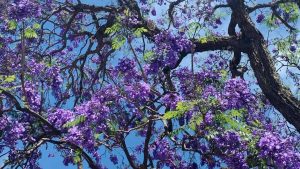
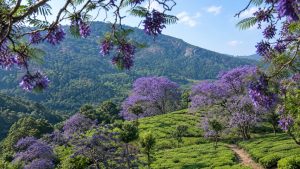
When the flowering season arrives, the green canopy gives way to thousands of soft purple-blue flower clusters. Walking beneath a street lined with jacaranda trees, especially in the gentle light of the changing season, can feel almost dreamlike. It is more than simply enjoying nature. It is a visual and emotional experience—a chance to see the world through different shades of purple.
The Origin and Story Behind the Name Jacaranda mimosifolia
Behind the poetic appearance of this tree is a precise scientific name: Jacaranda mimosifolia. It belongs to the Bignoniaceae family and is native to parts of South America, particularly Argentina and Bolivia.
The Meaning Behind the Name
The species name mimosifolia comes from the Latin words associated with Mimosa and folia, meaning leaf. The name refers to the tree’s finely divided, feathery leaves, which resemble the foliage of plants in the Mimosa group.
The leaves are one of the most distinctive features of the tree. They are made up of many small leaflets arranged along delicate stems, giving the canopy a soft and airy appearance.
A Striking Combination
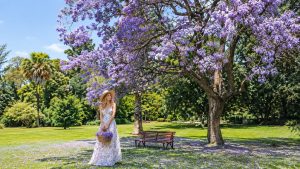
The fine texture of the foliage creates an interesting contrast with the clusters of trumpet-shaped flowers.
When the tree is in full bloom, the flowers seem to float among the delicate leaves and branches. Sunlight passing through the canopy can create shifting patterns of light and shadow, making the purple flowers appear even more striking.
A Symphony of Purple: How Light Changes the View
What makes Jacaranda mimosifolia so fascinating is not only its purple color, but also the way that color looks under different kinds of natural light throughout the day.
| Time of Day | Light Conditions | How the Flowers May Appear | Overall Feeling |
|---|---|---|---|
| Early Morning (6–8 a.m.) | Soft, cooler light | Light purple-blue with a subtle misty tone | Fresh, quiet, and delicate |
| Midday (11 a.m.–2 p.m.) | Strong, direct sunlight | More vivid purple with strong contrast against the blue sky | Bright, lively, and energetic |
| Late Afternoon (4:30–6 p.m.) | Warm, low-angle sunlight | Deeper purple with warmer tones | Calm, nostalgic, and atmospheric |
The flowers themselves are not actually changing color throughout the day. What changes is the way we see them.
Sunlight, shadows, the color of the sky, and the surrounding environment all affect how the purple flowers appear. A tree that looks soft and pale in the early morning can appear much richer under stronger afternoon light.
Standing beneath a flowering jacaranda gives you a chance to experience exactly what the title “A Dreamy View Through Shades of Purple” suggests—a landscape shaped by many subtle variations of the same beautiful color.
A Journey to Some of the World’s Famous Jacaranda Landscapes
Although Jacaranda mimosifolia originated in South America, it has been introduced to many parts of the world and has become closely associated with several cities and regions.
Pretoria, South Africa – The “Jacaranda City”
Few cities are as closely associated with jacaranda as Pretoria.
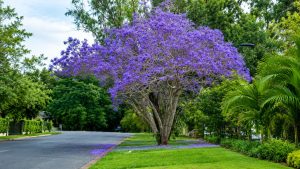
The city is famous for its large number of jacaranda trees planted along streets, in parks, and around university campuses. During the flowering season, the purple-blue canopy can transform large parts of the city.
From higher viewpoints around Pretoria, rows of flowering trees can appear to stretch across the landscape, creating long ribbons of purple among the streets and buildings.
This is one reason Pretoria earned its reputation as the “Jacaranda City.”
Grafton, Australia – A Long-Running Jacaranda Festival
In New South Wales, the city of Grafton is another well-known destination for jacaranda lovers.
Grafton is famous for its Jacaranda Festival, which has been held since 1934. During the flowering season, mature jacaranda trees add color to the city’s streets and historic surroundings.
The combination of old buildings, established trees, and purple flowers gives the city a distinctive seasonal atmosphere. For visitors, the trees are not simply part of the scenery—they are one of the reasons to experience the city during this time of year.
Da Lat, Vietnam – A Purple Mark on the City
In Vietnam, the story of Jacaranda mimosifolia is closely associated with Da Lat.
Purple jacaranda became part of the city’s landscape through the work of agricultural engineer Lương Văn Sáu, who is widely associated with bringing jacaranda planting material from France to Da Lat during the 1960s.
Over the years, the trees became part of Da Lat’s familiar spring scenery. When they bloom, the purple flowers appear along streets and around well-known areas of the city, creating a landscape that is closely connected with Da Lat in the minds of many visitors.
The flowering season is generally associated with the period from March to April, although timing can vary with weather and growing conditions.
Growing and Caring for Jacaranda mimosifolia in the Landscape
If you want to bring this purple display into a garden or landscape, understanding the tree’s basic growing requirements is important.
Climate and Sunlight
Jacaranda prefers plenty of sunlight and generally performs best with at least six hours of direct sun each day.
It is well suited to warm tropical and subtropical climates. Young trees are more sensitive to cold, and prolonged freezing conditions can cause serious damage.
In areas with cooler winters, choosing a protected planting location can make a significant difference.
Soil and Watering
Jacaranda is not particularly demanding about soil as long as the site drains well.
Sandy loam or light, organically enriched soil can provide good growing conditions. The main concern is avoiding soil that stays wet for long periods.
Young trees need regular watering while their root systems become established. Once mature, jacaranda can tolerate periods of dry weather, although prolonged drought may still affect growth and flowering.
Pruning and Training
Young trees may benefit from structural pruning to help develop a strong framework.
Dead, damaged, or poorly positioned branches can be removed when necessary. Avoid heavy pruning just before the flowering season because excessive cutting can remove branches that would otherwise produce flowers.
The goal is to maintain the tree’s natural shape rather than force it into an overly formal form.
Photography Tips for Enjoying Jacaranda
You do not need expensive camera equipment to capture the beauty of a flowering jacaranda. A good sense of composition and the right light can make a much bigger difference.
Try a “Frame Within a Frame”
Stand beneath the canopy and use branches and flower clusters around the edges of the image as a natural frame.
You can place a person, building, or distant street in the center of the composition. This creates a stronger sense of depth and makes the viewer feel as though they are standing beneath the tree.
Shoot From a Low Angle
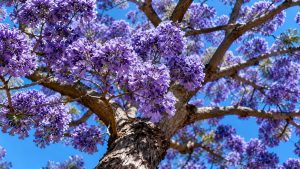
Point your camera upward through the branches and flowers.
The contrast between purple blossoms and blue sky can create a simple but striking image. This angle also helps show how large and full the canopy becomes when the tree is in bloom.
Do Not Ignore the Ground
Fallen flowers can be just as interesting as those still hanging from the branches.
When the flowers cover a sidewalk or patch of grass, try getting closer to the ground and using the fallen blossoms in the foreground. The flowering canopy in the background can then add depth to the photograph.
Choose Clothing That Works With the Flowers
If you are taking portraits beneath a jacaranda tree, neutral colors such as white, cream, beige, or soft pastels usually work well.
These tones stand out against the purple background without competing with the flowers.
Cultural Meaning and Emotional Appeal
Unlike flowers with bright, intense colors that are often associated with passion and energy, Jacaranda mimosifolia tends to create a quieter impression.
Its soft purple-blue flowers, delicate foliage, and short flowering season have given the tree different meanings in different places.
A Symbol of Student Life and Exam Season
In parts of South Africa and Australia, jacaranda flowering season coincides with the time when many students are preparing for final exams.
There is a popular piece of folklore that if a jacaranda flower falls on a student’s head during exam season, the student will pass the exams with excellent results.
Whether people actually believe it or simply enjoy the tradition, the story has become part of the cultural character surrounding these trees.
A Gentle Symbol of Renewal
Jacaranda can also remind people of seasonal change.
Depending on the climate, the tree may lose much of its foliage around the flowering period, leaving the branches more exposed before the new growth develops.
Then the flowers appear, bringing color back to the tree.
For many people, that seasonal change can naturally suggest renewal, new beginnings, and the idea of moving forward after a quiet period.
A Moment to Slow Down
There is something naturally calming about standing beneath a large flowering tree.
The combination of purple flowers, filtered sunlight, open branches, and fallen petals creates a peaceful visual setting. Rather than making a strong statement, jacaranda seems to encourage people to pause and simply take in the scenery.
That may be one reason flowering streets lined with jacarandas are so memorable.
Final Thoughts
Jacaranda mimosifolia is more than a shade tree or an ornamental addition to the landscape. It has become part of the identity of many places, from South America to South Africa, Australia, the United States, and Vietnam.
For a short period each year, its flowers can completely change the appearance of a street, garden, or city.
The purple canopy, the delicate leaves, the changing light, and even the flowers scattered across the ground all become part of the same seasonal scene.
The next time you find yourself walking beneath a jacaranda in bloom, there is no need to rush. Slow down for a moment, look up, and take in the different shades of purple around you.
That simple view may be the most beautiful part of the season.