Fenugreek is a fast-growing annual herb best known for its fragrant leaves and distinctive yellow-brown seeds. Scientifically called Trigonella foenum-graecum, it belongs to the legume family and has been cultivated for centuries across parts of Asia, the Middle East, and the Mediterranean region. For gardeners, fenugreek is especially interesting because it grows quickly, prefers cool conditions, and can be grown for its leaves, flowers, or mature seed pods.
What Is Fenugreek?
Fenugreek (Trigonella foenum-graecum) is an annual herb in the Fabaceae, or legume, family. It is also commonly called methi, particularly in South Asian culinary traditions. Kew’s Plants of the World Online recognizes Trigonella foenum-graecum as the accepted botanical name and gives its native range as extending from Iraq to northern Pakistan.
Distribution and Origin
The plant has a long history of cultivation, and its exact early origin is difficult to separate from its long agricultural history. Today, fenugreek is cultivated well beyond its native range, including parts of Europe, North Africa, Asia, and other regions with suitable growing conditions.
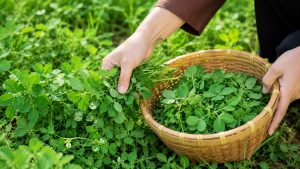
Fenugreek is a relatively small, upright annual. Under favorable conditions, it commonly reaches around 1 to 2 feet tall, although individual plants can vary. Its growth is relatively rapid, making it practical for gardeners who want a useful herb without waiting through several seasons.
Like other legumes, fenugreek has a relationship with soil microorganisms that allows it to fix atmospheric nitrogen. This is one reason it can fit nicely into a diverse garden rotation rather than being treated simply as another leafy herb. UC Master Gardeners describe it as a cool-season crop that can begin producing seed as temperatures rise in spring.
Fenugreek is also valued as a culinary and agricultural plant. Both the leaves and seeds have been used traditionally as food ingredients, seasonings, and forage. Kew’s Legumes of the World notes its importance as a condiment crop and its use of both seeds and leaves.
How to Identify Fenugreek
Fenugreek is fairly easy to recognize once you know its basic structure. It has an upright, somewhat clover-like appearance, which makes sense given its place in the legume family.
The stems are slender, green, and upright or slightly branching. Young plants often have a soft, fresh appearance, while mature plants become more structured as flowers and seed pods develop.
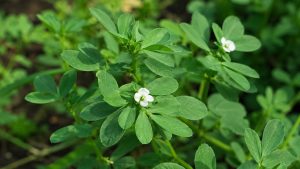
The leaves are one of the best identification features. They are divided into three small leaflets, giving the plant a trifoliate appearance similar to clover. The individual leaflets are generally oval to obovate and have lightly toothed edges. The foliage is green and aromatic, although the exact intensity can vary with growing conditions. Kew describes the plant as an erect, aromatic annual with three-part leaves.
The flowers are small and usually pale yellow to whitish. They develop in the leaf axils rather than forming large clusters at the top of the plant. Their pea-like structure is another useful clue that fenugreek belongs to the Fabaceae family.
After flowering, fenugreek produces elongated seed pods. These pods are narrow, pointed, and often slightly curved. Mature pods can reach several inches in length and contain multiple seeds. North Carolina State Extension describes the pods as long and thin, with approximately 10 to 20 seeds in each pod.
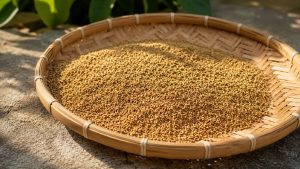
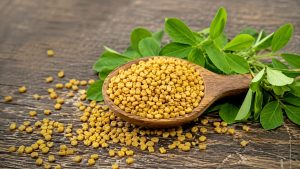
The seeds are particularly distinctive. They are angular or somewhat rhomboid, yellowish to yellow-brown, and strongly aromatic. Their unusual shape and color make mature fenugreek seed easy to distinguish from many other garden legumes.
One useful identification tip is to look at the whole plant rather than relying on one feature. The combination of trifoliate leaves, small pale flowers, narrow pointed pods, and strongly scented angular seeds is much more reliable than leaf shape alone.
How to Grow Fenugreek
Fenugreek is one of the more straightforward herbs to grow from seed. It prefers a sunny location, well-drained soil, and relatively cool growing conditions. In many American gardens, treating it as a cool-season annual produces better results than trying to keep it growing through the hottest part of summer.
Sunlight
Fenugreek grows best in full sun, generally receiving at least six hours of direct sunlight each day. Good light encourages compact growth and helps the plant flower and set seed properly. North Carolina State Extension lists full sun as the preferred light condition.
In regions with very hot summers, some afternoon protection can help extend the leafy stage. However, insufficient light may produce weaker, more stretched plants.
Soil
Choose a loose, fertile soil with good drainage. A loamy garden bed enriched with mature compost is a good starting point.
Fenugreek does not perform well in consistently waterlogged ground. Good drainage is particularly important because excess moisture around the roots can encourage rot and other problems. Extension guidance recommends well-amended soil with good drainage and avoiding overwatering.
For a garden focused on herbs and natural growing practices, incorporating finished compost or other well-aged organic matter before planting is usually preferable to relying heavily on synthetic fertilizers. The goal is healthy soil structure rather than excessive leafy growth.
Watering
Keep the soil moderately moist while seeds are germinating and young seedlings are becoming established. Once plants are growing well, allow the surface of the soil to dry slightly between waterings.
Fenugreek generally has relatively modest water requirements. Overwatering is more likely to cause trouble than allowing the soil to become briefly less moist.
A layer of light organic mulch can help moderate soil moisture, especially during periods of dry weather.
Temperature
Fenugreek is best suited to cool to moderate temperatures. North Carolina State Extension gives an ideal temperature range of approximately 45–80°F and notes that warm, dry conditions are useful for seed maturation.
In warm climates, sowing during a cooler part of the year is often more successful. In cooler regions, early-season planting can work once the soil is workable.
Planting and Propagation
Fenugreek is normally propagated from seed. Direct sowing is usually the simplest method because the plant develops quickly and does not require a long indoor-starting period.
Prepare a fine, loose seedbed and sow the seeds shallowly according to the instructions supplied with your seed. Keep the soil evenly moist until germination.
UC Master Gardeners recommend direct sowing fenugreek as a cool-season herb and note that it can also be grown indoors.
If growing primarily for leaves, successive sowings can provide a more continuous supply. If your goal is mature seed, allow enough time for flowering and pod development before harvesting.
Container Growing
Fenugreek can also be grown in containers. Choose a container with drainage holes and use a quality potting mix that does not remain soggy.
A wider container is useful if you want several plants together. Place it somewhere bright and monitor moisture more closely than you would in an in-ground bed because containers dry out faster.
Pruning and General Care
Fenugreek generally needs little pruning. Harvesting young leaves naturally encourages continued production for a while, but the plant will eventually shift toward flowering and seed production.
Keep weeds under control while seedlings are small. Once the plants become established, their foliage usually provides more competition against smaller weeds.
Common Growing Problems
The most common problem is excessive moisture. Poor drainage can create conditions favorable to root and stem problems.
Fenugreek can also be affected by certain fungal and bacterial diseases, including charcoal rot and bacterial problems, according to North Carolina State Extension. Caterpillar pests may occasionally feed on the foliage as well.
The best prevention is straightforward: use healthy seed, provide good air circulation, avoid constantly wet soil, and rotate crops rather than planting fenugreek repeatedly in exactly the same location.
How to Harvest and Store Fenugreek
Fenugreek can be harvested at different stages depending on whether you are growing it primarily for young foliage or mature seeds.
Young leaves and shoots can be harvested while the plants are actively growing. Use clean scissors to remove only the amount needed, leaving enough foliage for the plant to continue developing.
For seed production, allow the plant to flower and develop its characteristic narrow pods. The pods should be allowed to mature and dry before collecting the seeds. Mature pods become lighter and drier as the seeds finish developing.
Harvesting on a dry day is helpful because wet plant material is much harder to dry properly. Cut the mature portions and handle them gently to reduce seed loss.
For storage, remove dirt and damaged plant material first. Leaves intended for long-term storage should be dried thoroughly in a clean, well-ventilated area away from strong direct sunlight. They should feel dry and crisp before being placed in storage.
Mature seeds should also be completely dry before storage. Store dried fenugreek in an airtight container in a cool, dry, dark location. Glass jars or food-safe containers with tight-fitting lids work well.
Moisture is the biggest storage concern. If seeds or dried leaves develop condensation, clumping, visible mold, an unusual musty smell, or other signs of deterioration, they should be discarded rather than stored further.
Traditional Uses and History of Fenugreek
Fenugreek has a long and varied history of traditional use across North Africa, the Middle East, South Asia, and other regions. Historical records and ethnobotanical sources describe the plant as both a food ingredient and a traditional herb. Its seeds and leaves have been used in different cultural settings, while the plant has also served as livestock forage.
Fenugreek has a particularly strong place in the culinary traditions of South Asia, where the leaves are known as methi and the seeds have long been used as a spice. Its traditional history also extends into Ayurvedic and other regional systems of herbal practice. Historical sources describe a wide range of traditional applications, but these accounts reflect cultural practices rather than proof of modern medical effectiveness.
For modern readers, it is useful to keep two ideas separate. Traditional use documents what people historically did with a plant; it does not by itself establish that the plant can prevent, treat, or cure a medical condition. Modern scientific research continues to investigate fenugreek and its constituents, but historical use and scientific evidence should not be treated as interchangeable.
Conclusion
Fenugreek is a compact, aromatic annual legume that fits especially well into gardens with cool growing seasons. Its trifoliate leaves, pale flowers, narrow seed pods, and distinctive angular seeds make it relatively easy to identify. Give it full sun, fertile well-drained soil, moderate moisture, and good air circulation for reliable growth. Harvest young foliage early or allow plants to mature for seed production. Proper drying and dry, dark storage help preserve the botanical material for longer-term keeping. Its long culinary and traditional history adds another interesting layer to this useful garden herb.
Frequently Asked Questions
What is fenugreek?
Fenugreek is an annual legume scientifically known as Trigonella foenum-graecum. It is grown for its aromatic leaves and distinctive seeds and has a long history as a culinary and traditional herb.
Where does fenugreek grow?
Fenugreek is native to a region extending from Iraq to northern Pakistan and is now cultivated in many other parts of Asia, Europe, Africa, and elsewhere.
How do you identify fenugreek?
Look for trifoliate leaves, slender upright stems, small pale yellow or whitish flowers, and long narrow seed pods. The mature seeds are angular, yellow-brown, and strongly aromatic.
How do you grow fenugreek?
Grow fenugreek from seed in well-drained soil with plenty of sunlight. Keep young plants moderately moist but avoid waterlogged soil. It generally performs best during cooler growing periods.
How much sunlight does fenugreek need?
Fenugreek prefers full sun, with about six or more hours of direct sunlight daily. In very hot regions, some afternoon protection may help extend the cool-season growing period.
How do you harvest and store fenugreek?
Harvest young leaves while plants are actively growing. For seeds, wait until the pods mature and dry. Dry harvested material thoroughly and store it in an airtight container away from moisture, heat, and direct light.
What is fenugreek traditionally used for?
Fenugreek has historically been used as a food, spice, forage plant, and traditional herb in several cultures. Historical herbal uses should be understood as part of ethnobotanical history rather than as evidence that fenugreek can treat or prevent medical conditions.