I’d like to share some of my experience growing Nepenthes after years of caring for these plants. The tips below are based on the way I grow and care for my plants in my own garden. Growing conditions can be different from one place to another, so this is simply what has worked well for me.

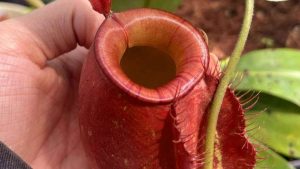
One of the Nepenthes I enjoy growing is Nepenthes northiana. It is native to Borneo, particularly the Sarawak region of Malaysia. I really like this species because of its unusual pitchers and distinctive appearance.
However, Northiana is not one of the easiest Nepenthes to grow. When the plant is still young, growth can be quite slow. Getting it to produce well-formed pitchers also takes some patience. I have found that keeping the growing conditions stable is more useful than constantly changing the way I care for it.
The first thing I do is choose a separate area for the plant. It does not have to be very large, especially when the plant is still small. I mainly want a space where I can keep an eye on the plant and control its growing conditions.
I usually place the Nepenthes in the middle of the area and grow some ferns around it. I like this arrangement because it gives the area a more natural look instead of leaving the plant sitting alone in an open space.
You do not have to use ferns. Other suitable plants can work as well. For me, the main idea is to create a green, natural-looking environment around the Nepenthes.
Watering Nepenthes
Watering is something I pay close attention to, especially during hot weather.
In my garden, I usually water twice a day. I water once in the early morning and again in the late afternoon when the weather is cooler.
I prefer these two times because the temperature is not as high as it is around midday. I also find it easier to keep the growing area consistently moist this way.
Of course, I adjust the watering depending on the weather. During rainy periods, I pay more attention to the actual condition of the growing area rather than watering simply because it is part of my normal schedule.
I try not to let the plant stay excessively dry for long periods, but I also do not want the growing area to remain waterlogged.
Providing the Right Light
Light is another part of my routine that I have paid a lot of attention to over the years.
I grow my Northiana under a layer of shade netting rather than leaving it exposed to strong sunlight all day. In my garden, the plant gets filtered light from around 9 a.m. until about 1 p.m.
In the afternoon, it receives some lighter direct sunlight from around 3 p.m. to 5 p.m.
This is the setup I have been using for my plant, and it has worked well under my local conditions. I prefer giving the plant consistent light rather than moving it around frequently.
If the weather becomes particularly hot, I pay closer attention to how the leaves look and adjust the shade if necessary.
Temperature and Garden Conditions
I do not regularly measure the temperature in my growing area, so I cannot give an exact figure.
Because I grow the plant in a warm climate, I estimate that temperatures are generally around 82–91°F (28–33°C), depending on the time of day and weather conditions.
Rather than trying to maintain an exact temperature, I focus more on keeping the growing area comfortable and stable. The shade net, surrounding plants, regular watering, and good garden conditions all work together.
Using Root Support Products
When it comes to feeding and plant care, I keep things fairly simple.
I sometimes use products that I normally use to support root development. The ones I have used include N3M and B1, generally about once a week.
I also use Superthrive as an additional plant-support product.
These are simply part of my own routine. I do not keep adding more and more products just because the plant is growing slowly. With Northiana, I have found that patience is important.
I prefer to keep my routine consistent and watch how the plant responds over time.
Preventing Fungal Problems
I also pay attention to fungal problems, especially during the rainy season.
Under normal conditions, I use a fungicide about once a month as part of my routine. During the rainy season, when the weather stays wet and humid for longer periods, I usually increase this to about once every two weeks.
I also keep an eye on the plant instead of relying only on a spraying schedule. When the weather stays wet for several days, I check the leaves and the growing area more often.
For me, keeping the area from becoming excessively stagnant or overly wet is just as important as regular maintenance.
Be Patient With Northiana
One of the biggest things I have learned from growing Northiana is to be patient.
This species can be slow when it is young, so I do not expect the plant to change dramatically in a short period of time. The Northiana in my garden has been growing for more than a year, and it was already a fairly large plant when I bought it.
I have continued to keep the growing conditions relatively stable rather than constantly changing things whenever the plant grows slowly.
The pitchers are one of the main reasons I enjoy growing this species. Getting those beautiful Northiana pitchers takes time, but that is also part of what makes growing the plant interesting.
Final Thoughts
These are some of the Nepenthes growing tips I have learned from years of caring for plants in my own garden. For my Northiana, I focus mainly on filtered light, regular watering, suitable humidity, a natural growing area, and consistent care.
My current routine is fairly simple: I grow the plant under shade netting, water in the early morning and late afternoon, surround it with suitable greenery, and pay extra attention during the rainy season.
Every garden has different conditions, so what works for me may need to be adjusted elsewhere. I think the most important thing is to watch the plant and give it time to adapt.
With a little patience and consistent care, hopefully we can all enjoy seeing more beautiful Northiana pitchers develop in our gardens.