When it comes to expanding your backyard orchard or starting a commercial longan (Dimocarpus longan) enterprise, choosing the right propagation method is the single most critical decision you will make.
While growing longan from seeds is a fun experiment, it is rarely practical for fruit production. Seedling trees take many years to bear fruit, and the genetic variation means the harvest may be sour, small, or of generally poor quality.
To bypass these frustrations, growers turn to asexual propagation techniques. Among the advanced methods available, air-layering (marcotting) and grafting stand out as the gold standards.
Both techniques allow you to clone the exact desirable traits of a mother tree—such as exceptional sweetness, large fruit size, and disease resistance. However, they differ significantly in execution, root system development, and long-term tree vigor.
This guide dives deep into the mechanics of air-layering and grafting, comparing their pros and cons, and helping you determine which technique best suits your gardening goals.
1. Understanding Air-Layering (Marcotting)
Air-layering is an ancient horticultural technique that induces a branch to develop roots while it is still attached to the parent tree. Because the branch relies on the mother tree for water and nutrients during the rooting process, it remains alive and vigorous while new roots form in a protected medium.
The Step-by-Step Air-Layering Process
- Selecting the Branch: Choose a healthy, disease-free branch from the current or previous season’s growth, roughly the thickness of a pencil or your thumb.
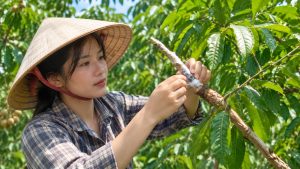
- Girdling (Ring Barking): Make two parallel cuts around the branch about 1 to 1.5 inches apart, cutting through the bark and the phloem layer down to the woody xylem. Strip the bark away completely to expose the hard wood.
- Applying Rooting Hormone: Brush a rooting hormone powder or gel onto the upper cut to stimulate aggressive root initiation.
- Wrapping the Medium: Enclose the wounded area in a moisture-retaining medium, typically moist sphagnum moss, coco coir, or a mix of compost and soil. Wrap this securely in clear plastic sheeting and tie both ends tightly with twine or zip ties to lock in moisture.
- Harvesting: Over the course of 8 to 12 weeks, a dense network of roots will become visible through the clear plastic. Once the roots turn a healthy brown and fill the medium, cut the branch cleanly just below the root ball and pot it up.
Advantages of Air-Layering
- High Success Rate: Because the branch is constantly supported by the parent tree, beginners often find air-layering more forgiving than delicate grafting cuts.
- Immediate Size: You can air-layer relatively large branches (even 2 to 3 feet long), giving you a substantial, near-mature tree much faster than starting with a tiny whip.
- No Rootstock Incompatibility: The resulting tree owns its own root system, meaning there is no graft union that could fail or suffer from rootstock-scion rejection.
Disadvantages of Air-Layering
- Weaker Root Systems: Air-layered trees lack a deep taproot. Their root systems tend to be shallow and spreading, making them more susceptible to windthrow or drought stress if not properly managed.
- Limited Quantity: You can only take as many air-layers as the parent tree can comfortably spare without ruining its structural integrity.
2. Exploring Grafting Techniques
Grafting is the art and science of joining two separate woody plants together so they grow as a single organism. The upper portion, known as the scion, provides the desired fruit variety, while the lower portion, known as the rootstock, provides the root system. For longan trees, nursery professionals frequently utilize whip-and-tongue, cleft, or side-veneer grafting.
The Step-by-Step Grafting Process
- Rootstock Preparation: Grow a robust rootstock from seed until it reaches pencil thickness (usually 6 to 12 months old). Cut the top off cleanly.
- Scion Collection: Harvest a dormant, disease-free scion wood stick from a proven, high-yielding mature longan tree.
- Making the Cuts: Cut matching, precise slanting angles into both the rootstock and the scion so their cambium layers (the green ring just beneath the bark) align perfectly.
- Binding and Sealing: Bind the union tightly with grafting tape or parafilm to hold the pieces together and prevent moisture loss. Cover any exposed cut surfaces with grafting wax or sealant.
Advantages of Grafting
- Superior Root Vigor: Grafted trees often utilize rootstocks selected for specific soil conditions, such as resistance to root rot (Phytophthora) or tolerance to poor, heavy soils.
- Deep Root Architecture: Seed-grown rootstocks develop natural taproots, providing superior structural anchor and drought resilience.
- Mass Production: Nurseries can produce hundreds of clones efficiently using rootstocks and scion wood.
Disadvantages of Grafting
- Steeper Learning Curve: Precise matching of the cambium layer requires steady hands, sharp tools, and practice. A mismatch leads to immediate failure.
- Graft Failure Risk: Extreme weather or physical impact can occasionally snap or damage the tree right at the weak point of the graft union.
3. Direct Comparison: Air-Layering vs. Grafting
To help you visualize how these two advanced propagation methods stack up against each other, consider the following breakdown:
| Feature | Air-Layering (Marcotting) | Grafting |
|---|---|---|
| Root System | Shallow, fibrous, lacks a true taproot | Deep, structured, often includes a taproot |
| Skill Level Required | Beginner to Intermediate | Intermediate to Advanced |
| Time to Fruit Production | Fast (often flowers and fruits within 1–2 years) | Fast, provided a grafted longan fruit tree is used |
| Wind Resistance | Moderate (shallow roots make it prone to leaning) | High (strong rootstock anchor) |
| Material Efficiency | Limited by the number of suitable branches on the parent | High (one scion stick can yield multiple cuts) |
4. Making Your Choice: Which Method Should You Use?
The choice between air-layering and grafting ultimately depends on your resources, environment, and specific goals as a grower:
- Choose Air-Layering if: You have access to a mature, high-performing longan tree in your yard and want to propagate exact clones for yourself or neighbors without investing in rootstock seedlings. It is also the ideal method if you want a larger plant faster and have an environment protected from severe hurricanes or strong winds.
- Choose Grafting if: You are managing a commercial nursery, dealing with challenging soil pathogens, or need trees with deeply anchored root systems to withstand harsh weather conditions.
Gardeners often prefer air-layering over seeds because a grafted longan fruit tree usually produces a higher-quality harvest much sooner. However, combining both methods in an advanced orchard setup allows you to maximize your yields and enjoy sweet, tropical longans year after year.