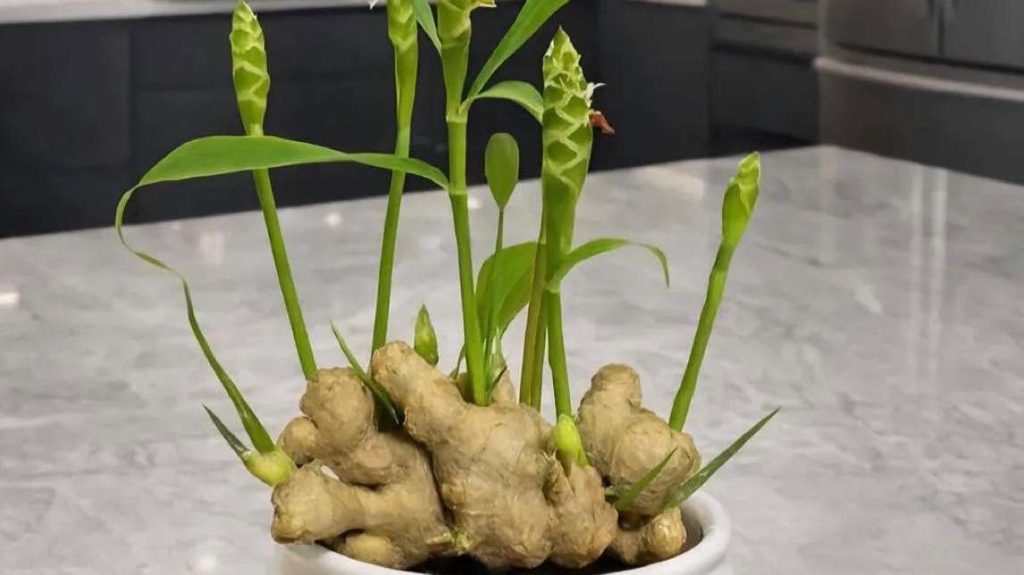
Understanding the differences between turmeric varieties can help gardeners and farmers choose the right type for their growing conditions and intended use.
1. Alleppey Finger Turmeric
Alleppey Finger Turmeric is a well-known turmeric type associated with the Alleppey region of Kerala, India.
It is valued for its strong golden-orange color and relatively high curcumin content. The rhizomes are commonly used for producing turmeric powder and other processed turmeric products.
This variety is particularly popular in commercial spice production because of its attractive color and strong flavor.
For farmers interested in producing turmeric for processing, Alleppey Finger Turmeric can be an interesting option where suitable planting material is available.
2. Madras Turmeric
Madras Turmeric is another well-known type associated with southern India.
Compared with some other turmeric types, Madras turmeric is often recognized for its lighter yellow color and lower curcumin content.
It is widely used as a culinary spice and can be suitable for applications where a milder color is preferred.
The variety is also known in international spice markets and may be used in different food-processing applications.
3. Salem Turmeric
Salem Turmeric is associated with the Salem region of Tamil Nadu, India, which is an important turmeric-producing area.
The rhizomes are commonly used for spice production and processing. Salem is known for turmeric cultivation, and local varieties are valued for their quality and commercial importance.
Farmers growing turmeric for the spice market may consider varieties adapted to their local climate and soil conditions rather than selecting a variety based only on its name.
4. Erode Turmeric
Erode is another major turmeric-growing region in India, and Erode Turmeric is widely recognized in the turmeric trade.
The region has a long history of turmeric cultivation, processing, and marketing.
Turmeric from Erode is commonly used in food and spice applications. The local production system also demonstrates how regional growing conditions, farmer experience, processing facilities, and established markets can influence the commercial success of a turmeric crop.
5. Lakadong Turmeric
Lakadong Turmeric is a highly regarded traditional turmeric type associated with Meghalaya in northeastern India.
It is often recognized for its naturally high curcumin content and strong golden color. The variety has gained attention among consumers and businesses interested in premium turmeric products.
Lakadong turmeric is traditionally cultivated by farmers in the Jaintia Hills region.
Because of its reputation, it is often considered a specialty turmeric type. However, availability of authentic planting material may be limited outside its traditional growing region.
6. Duggirala Turmeric
Duggirala Turmeric is associated with the Duggirala region of Andhra Pradesh, India.
The variety has commercial importance and has traditionally been cultivated for spice production.
Like other regional turmeric types, its performance can depend on local growing conditions, planting material, soil fertility, and farm management.
Farmers considering this type should evaluate whether it is suitable for their climate and whether reliable planting material is available.
7. IISR Prathibha
IISR Prathibha is an improved turmeric variety developed by the Indian Institute of Spices Research.
Improved varieties such as Prathibha are developed with specific agricultural characteristics in mind, including yield, quality, and adaptation to cultivation.
For commercial growers, improved varieties can be attractive because they may offer more consistent performance than traditional planting material.
However, farmers should always consider local recommendations before selecting a variety for large-scale production.
8. IISR Alleppey Supreme
IISR Alleppey Supreme is another improved turmeric variety associated with research and development in India.
It was developed to provide useful characteristics for turmeric cultivation and production.
Improved varieties may be selected based on factors such as rhizome yield, quality, maturity period, and suitability for processing.
The availability of certified planting material can vary by region, so growers should check with local agricultural institutions or reputable suppliers.
9. Wild Turmeric
Wild turmeric, often known botanically as Curcuma aromatica, is related to the common culinary turmeric, Curcuma longa.
It is sometimes called wild turmeric or aromatic turmeric.
Unlike culinary turmeric, wild turmeric is not typically the primary source of the turmeric powder commonly used as a cooking spice.
It has traditionally been used in various cultural and cosmetic applications and is valued for its distinctive aroma.
Gardeners should not automatically assume that all plants sold as “wild turmeric” are interchangeable with culinary turmeric.
10. White Turmeric
White turmeric is another related plant commonly known as Curcuma zedoaria.
Its rhizomes have a pale or whitish interior compared with the bright orange-yellow color of common turmeric.
White turmeric has a distinctive aroma and has been used traditionally in various culinary and cultural applications in parts of Asia.
It should be considered a different type of Curcuma rather than simply a white-colored version of standard culinary turmeric.
How to Choose the Right Turmeric Variety
The best turmeric variety depends on what you want to do with the crop.
If your goal is home cooking, choose a culinary turmeric variety that produces flavorful rhizomes and grows well in your local climate.
For commercial production, farmers may consider yield, maturity time, disease resistance, curcumin content, rhizome quality, and market demand.
For processing into powder, varieties with strong color and suitable curcumin levels may be attractive.
For fresh markets, appearance, size, texture, and flavor may be more important.
Local climate is also a major consideration. A variety that performs well in one region may not produce the same results in another.
Traditional vs. Improved Varieties
Traditional turmeric varieties are often closely connected to specific growing regions. They may have unique characteristics developed through generations of cultivation.
Improved varieties, on the other hand, are generally selected or developed to provide specific agricultural advantages, such as higher yields or improved quality.
Neither type is automatically best for every farmer. The right choice depends on the intended market, growing conditions, availability of planting material, and production goals.
Final Thoughts
There are many different types of turmeric, ranging from traditional regional varieties to improved commercial cultivars and related Curcuma species.
Popular types include Alleppey Finger, Madras, Salem, Erode, Lakadong, and Duggirala turmeric, while improved varieties such as IISR Prathibha and IISR Alleppey Supreme are also used in cultivation.
Related plants such as wild turmeric and white turmeric are different from the common culinary turmeric used to make traditional spice powder.
When choosing among turmeric varieties, gardeners and farmers should consider climate, soil, intended use, yield, quality, and market demand. Selecting planting material that is well adapted to local conditions is often one of the most important factors in achieving healthy growth and a successful harvest.