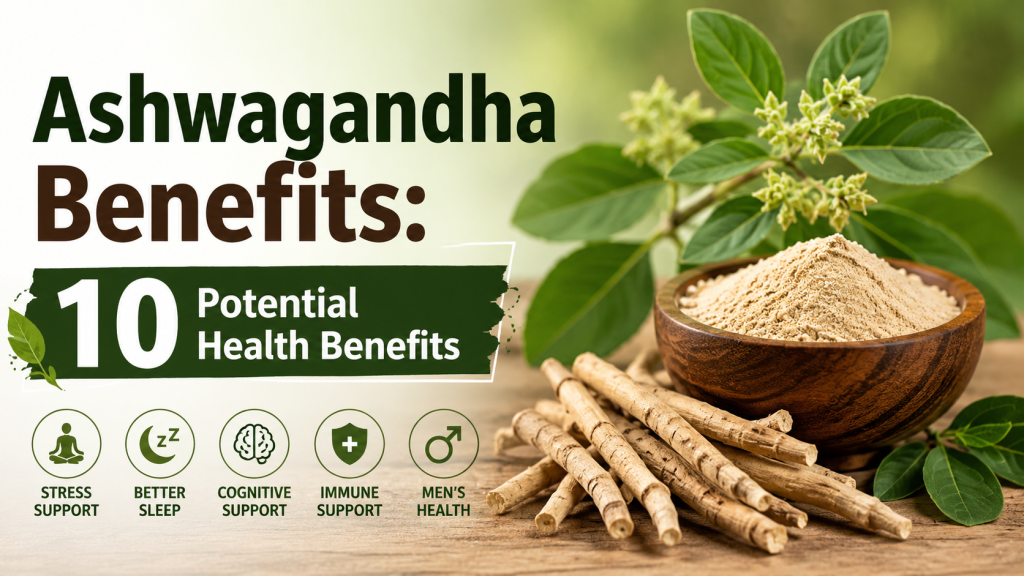
Ashwagandha benefits have attracted growing interest due to the herb’s potential effects on stress, sleep, energy, male reproductive health, and overall wellness. Traditionally used in Ayurvedic medicine, Ashwagandha contains compounds called withanolides that have been studied for their potential antioxidant and anti-inflammatory properties. In this guide, we’ll explore the most promising potential benefits of Ashwagandha and what current research says about them.
Table of Contents
- 1. May Help Reduce Stress
- 2. May Support Better Sleep
- 3. May Support Relaxation and Emotional Well-Being
- 4. May Support Male Reproductive Health
- 5. May Support Healthy Cortisol Levels
- 6. May Have Antioxidant and Anti-Inflammatory Properties
- 7. May Support Energy and Overall Vitality
- 8. May Support Cognitive Function
- 9. May Support Healthy Hormonal Balance
- 10. May Support General Wellness
- Final Thoughts on Ashwagandha Benefits
- Safety and Precautions
1. May Help Reduce Stress
One of the best-known potential benefits of Ashwagandha is its role in managing stress.
Chronic stress can affect both mental and physical well-being. It may contribute to poor sleep, fatigue, difficulty concentrating, and changes in mood. Ashwagandha has traditionally been considered an adaptogenic herb, meaning it may help the body respond to physical and emotional stress.
Some clinical research suggests that Ashwagandha supplementation may help reduce perceived stress and levels of cortisol, a hormone involved in the body’s stress response.
This is one of the areas where the evidence is relatively promising. The National Center for Complementary and Integrative Health (NCCIH) notes that some Ashwagandha preparations may be effective for stress, although more research is needed to determine the best preparations and long-term effects.
2. May Support Better Sleep
Another important Ashwagandha benefit is its potential to support sleep quality.
People experiencing ongoing stress often have difficulty falling asleep or staying asleep. Because Ashwagandha may help the body manage stress, researchers have investigated whether it can also improve sleep.
Some studies have found that certain Ashwagandha extracts may improve sleep quality and help people with insomnia-related symptoms. Research reviewed by NCCIH suggests that some preparations may be helpful for insomnia.
The potential sleep benefit may be especially relevant for people whose sleep difficulties are associated with stress. However, Ashwagandha should not be considered a replacement for good sleep habits or professional care when persistent sleep problems are present.
3. May Support Relaxation and Emotional Well-Being
Ashwagandha is also widely used for its potential calming effects.
Some research has explored whether the herb may help people feel more relaxed and support emotional well-being. Its possible effects on the body’s stress response may partly explain why it is often included in supplements designed for relaxation.
However, the evidence for anxiety is less clear than the evidence for stress. NCCIH states that research findings are not yet sufficient to determine whether Ashwagandha consistently helps with anxiety.
For this reason, it is more accurate to describe Ashwagandha as a potential stress-supporting herb rather than a proven treatment for anxiety disorders.
4. May Support Male Reproductive Health
Ashwagandha has also received attention for its potential effects on male reproductive health.
Some research suggests that taking certain Ashwagandha preparations for several months may increase testosterone levels and improve sperm quality in some men. This has contributed to growing interest in Ashwagandha among people looking for natural approaches to support male fertility and reproductive wellness.
However, the evidence remains limited. NCCIH reports that there is some evidence suggesting Ashwagandha taken for two to four months may increase testosterone levels and sperm quality, but more high-quality research is needed.
Therefore, Ashwagandha may have potential in this area, but it should not be viewed as a guaranteed fertility treatment.
5. May Support Healthy Cortisol Levels
Cortisol is a hormone that plays an important role in the body’s response to stress. It is essential for normal physiological functions, but prolonged stress can affect cortisol regulation.
Because Ashwagandha may influence the body’s stress response, researchers have studied its potential effects on cortisol levels.
Some clinical trials have reported reductions in cortisol among people experiencing chronic stress. This may be one reason Ashwagandha is often associated with relaxation and stress management.
Still, cortisol is only one part of a much larger system. A lower cortisol level is not automatically better in every situation, so Ashwagandha should not be viewed simply as a supplement for “lowering cortisol.” Its potential benefit may be better understood as supporting a healthier response to stress.
6. May Have Antioxidant and Anti-Inflammatory Properties
Ashwagandha contains naturally occurring compounds called withanolides. These compounds have attracted scientific interest because laboratory and preclinical research has associated them with antioxidant and anti-inflammatory activity.
Antioxidants help protect cells from oxidative stress, while inflammation is a natural part of the body’s immune response. Maintaining a healthy balance between oxidative processes and inflammation is important for overall health.
However, laboratory findings do not always translate directly into proven health benefits in humans. More clinical research is needed to determine how these properties may affect people who take Ashwagandha supplements.
For now, the antioxidant and anti-inflammatory potential of Ashwagandha is an interesting area of research rather than a confirmed treatment for inflammatory conditions.
7. May Support Energy and Overall Vitality
Ashwagandha has traditionally been used in Ayurveda as a restorative herb. Modern supplements often market it for energy, stamina, and general vitality.
Some people use Ashwagandha as part of a wellness routine because of its potential effects on stress and sleep. If stress is reduced and sleep quality improves, a person may naturally feel more energetic during the day.
Researchers have also investigated Ashwagandha in relation to physical performance and exercise. However, NCCIH states that there is currently not enough evidence to determine whether Ashwagandha consistently improves athletic performance.
Therefore, its potential contribution to energy may be indirect and related to overall well-being rather than acting like a stimulant.
8. May Support Cognitive Function
Ashwagandha has attracted interest for its possible effects on memory, attention, and other aspects of cognitive function.
Traditional use and early research have led scientists to investigate whether the herb may support mental performance, particularly in relation to stress. Since chronic stress and poor sleep can affect concentration and memory, improving these areas could potentially contribute to better cognitive well-being.
However, the current evidence is not strong enough to confirm Ashwagandha as an effective cognitive supplement. NCCIH specifically notes that there is not enough evidence to determine whether Ashwagandha benefits cognitive function.
More large-scale human studies are needed before this potential benefit can be considered well established.
9. May Support Healthy Hormonal Balance
Ashwagandha is sometimes promoted as a herb that supports hormonal balance. This interest comes partly from research involving stress hormones and testosterone.
Some studies have observed changes in cortisol levels, while limited evidence suggests potential effects on testosterone in certain men. These findings have led to interest in Ashwagandha as a natural supplement for supporting hormonal health.
However, hormonal systems are complex, and the effects of Ashwagandha may vary significantly between individuals. It should not be assumed to “balance hormones” in everyone or to treat hormone-related medical conditions.
People with thyroid disorders or other hormone-related health concerns should be especially cautious, as NCCIH notes that Ashwagandha may interact with thyroid hormone medications and is not recommended for people with certain thyroid conditions without appropriate medical guidance.
10. May Support General Wellness
Perhaps the broadest potential Ashwagandha benefit is its role as part of an overall wellness routine.
The herb has a long history of traditional use, and modern research continues to investigate its effects on stress, sleep, reproductive health, and other areas. For some people, the combination of potential stress support, improved sleep, and overall resilience may make Ashwagandha an appealing addition to a healthy lifestyle.
At the same time, it is important to keep expectations realistic. Current research does not support the idea that Ashwagandha is a cure-all or that it can prevent or treat every health condition.
The strongest evidence currently appears to be related to stress and insomnia, while research into areas such as cognitive function, athletic performance, diabetes, menopause, and female infertility remains insufficient to draw firm conclusions.
Final Thoughts on Ashwagandha Benefits
Ashwagandha is a traditional herb with a growing body of modern research behind it. Among its potential benefits, supporting stress management and sleep are two of the most promising areas. There is also limited evidence for possible benefits related to testosterone and sperm quality in some men.
Other potential benefits—including antioxidant activity, cognitive support, energy, exercise performance, and hormonal health—remain areas of ongoing research.
It is also important to remember that Ashwagandha products can differ considerably in their extracts and formulations, which makes it difficult to compare results across studies. More high-quality clinical trials are needed to understand which preparations are most effective and how they should be used.
Ashwagandha may be a useful addition to a healthy lifestyle for some adults, but it should not replace a balanced diet, regular physical activity, adequate sleep, or medical care.
Safety and Precautions
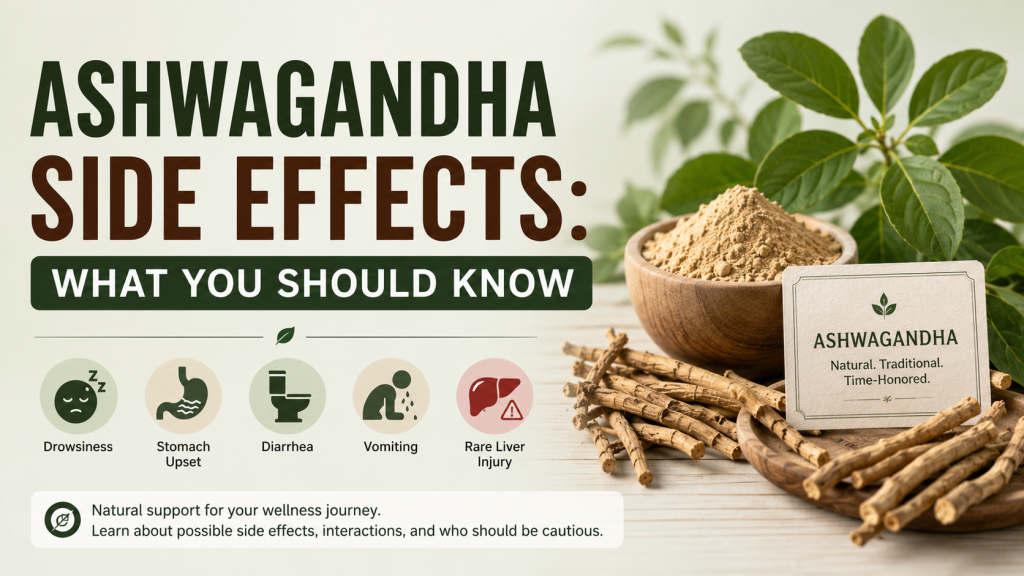
Ashwagandha may be safe for short-term use of up to three months, but long-term safety is unclear. Possible side effects include drowsiness, stomach upset, diarrhea, and vomiting. Rare liver injuries have also been reported. (Source: NCCIH)
It should be avoided during pregnancy and breastfeeding and may interact with certain medications. People with thyroid or autoimmune conditions, or those preparing for surgery, should consult a healthcare professional before use. (Source: NCCIH)
Overall, Ashwagandha may offer benefits for stress and sleep, but more research is needed to confirm other potential uses. (Sources: NCCIH; NIH)