Hydrangeas are one of the most beautiful flowering shrubs you can grow in a home garden. With their large flower clusters, lush green foliage, and long blooming season, hydrangeas can add color and charm to landscapes, borders, containers, and shaded garden spaces.
The good news is that learning how to grow hydrangeas is relatively simple. With the right location, soil, water, and basic care, these flowering shrubs can thrive for many years.
In this beginner-friendly guide, you will learn how to plant hydrangeas, how often to water them, how much sunlight they need, how to fertilize them, when to prune them, and how to keep them healthy throughout the growing season.
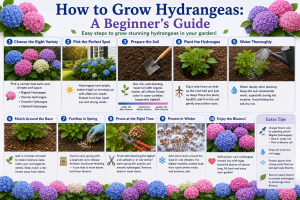
1. Choose the Right Hydrangea Variety
Before planting, it is important to choose a hydrangea variety that suits your garden conditions. Different types have different sunlight, pruning, and cold-hardiness requirements.
Some popular types include:
Bigleaf Hydrangeas
Bigleaf hydrangeas are known for their large, colorful flower heads. Depending on the variety and soil conditions, flowers may appear blue, purple, pink, or a combination of these colors.
They generally prefer morning sun and afternoon shade, especially in warmer climates.
Panicle Hydrangeas
Panicle hydrangeas are among the easiest hydrangeas for beginners. They can tolerate more sunlight than many other types and produce large cone-shaped flower clusters.
They are a good choice for gardeners who have a sunny planting location.
Smooth Hydrangeas
Smooth hydrangeas are hardy shrubs that produce large, rounded flower clusters. They are often white or greenish at first and may change color as the flowers mature.
They can grow well in partial shade and are relatively easy to care for.
Oakleaf Hydrangeas
Oakleaf hydrangeas have distinctive leaves that resemble oak leaves. In addition to beautiful flowers, their foliage can provide attractive fall color.
They generally prefer partial shade and well-drained soil.
Climbing Hydrangeas
Climbing hydrangeas are different from shrub-type hydrangeas because they can grow vertically along walls, fences, and other supports.
They grow slowly when young but can become impressive landscape plants once established.
2. Choose the Best Location
Choosing the right location is one of the most important steps when growing hydrangeas.
Most hydrangeas prefer bright light but do not always perform well in intense afternoon sun. A location with morning sunlight and afternoon shade is often ideal.
In cooler climates, some varieties can tolerate more direct sunlight. In hot climates, afternoon shade can help protect the leaves and flowers from heat stress.
When choosing a planting location, consider:
- Morning sunlight
- Afternoon shade
- Protection from strong winds
- Good air circulation
- Well-drained soil
- Enough space for mature growth
Avoid planting hydrangeas in areas where water regularly collects after heavy rain. Constantly wet soil can cause root problems.
3. Prepare the Soil
Hydrangeas generally grow best in rich, well-draining soil that contains plenty of organic matter.
Before planting, loosen the soil and mix in compost or other well-rotted organic matter if the soil is poor.
The ideal soil conditions can vary by hydrangea type, but most prefer slightly acidic to neutral soil.
Good soil preparation helps the roots establish more easily and improves the plant’s ability to absorb water and nutrients.
If your soil is heavy clay, improving drainage is especially important. You can add organic matter to improve soil structure, but avoid creating a planting hole that holds water like a container.
4. How to Plant Hydrangeas
The best time to plant hydrangeas is usually spring or fall when temperatures are mild.
Follow these steps:
Step 1: Dig the Planting Hole
Dig a hole that is about twice as wide as the root ball. The depth should be approximately the same as the height of the root ball.
Step 2: Remove the Plant Carefully
Gently remove the hydrangea from its container. Avoid pulling aggressively on the stems.
If the roots are tightly packed, gently loosen a few roots around the outside of the root ball.
Step 3: Place the Hydrangea
Set the plant in the hole so that the top of the root ball is level with or slightly above the surrounding soil.
Avoid planting too deeply because this can interfere with healthy root development.
Step 4: Fill the Hole
Backfill the hole with the original soil mixed with organic matter if needed.
Press the soil gently around the roots to remove large air pockets.
Step 5: Water Thoroughly
Water the plant deeply after planting. This helps settle the soil around the roots and gives the hydrangea a good start.
5. How Much Sunlight Do Hydrangeas Need?
The amount of sunlight hydrangeas need depends on the variety and climate.
As a general rule, many hydrangeas grow well with several hours of sunlight each day, especially morning sun.
In hot climates, too much intense afternoon sunlight can cause:
- Wilting leaves
- Scorched foliage
- Faster moisture loss
- Shorter-lasting flowers
If your hydrangea is struggling in a very sunny location, consider providing afternoon shade.
On the other hand, too much shade can reduce flowering. If your plant produces healthy leaves but very few flowers, insufficient light may be one possible cause.
6. How to Water Hydrangeas
Hydrangeas need consistent moisture, especially during their first growing season.
Newly planted hydrangeas should be watered regularly while their roots become established.
Once established, water when the top layer of soil begins to dry. The exact frequency depends on your climate, soil type, plant size, and weather conditions.
During hot or dry periods, hydrangeas may need more frequent watering.
Water deeply at the base of the plant rather than frequently spraying the leaves. A layer of mulch around the root zone can help the soil retain moisture.
However, avoid keeping the soil constantly soggy.
Signs that a hydrangea may need more water include:
- Drooping leaves
- Dry soil
- Wilting during hot weather
- Brown or crispy leaf edges
If the plant frequently wilts despite regular watering, check the soil drainage and root conditions.
7. Add Mulch Around the Plant
Mulching is a simple way to help hydrangeas stay healthy.
Apply a layer of organic mulch, such as shredded bark, compost, or leaf mold, around the base of the plant.
Mulch can help:
- Keep soil moisture more consistent
- Protect roots from temperature changes
- Reduce weed growth
- Improve soil quality as it breaks down
Keep mulch a few inches away from the main stems. Piling mulch directly against the stems can create overly damp conditions and encourage problems.
8. How to Fertilize Hydrangeas
Hydrangeas generally benefit from moderate fertilization, especially when grown in nutrient-poor soil.
A balanced, slow-release fertilizer can be applied according to the product instructions.
Avoid excessive fertilization. Too much nitrogen can encourage lots of green leafy growth while reducing flowering.
The best fertilization schedule depends on the hydrangea variety and local growing conditions.
For many gardeners, applying fertilizer in spring as new growth begins is a good starting point. Some varieties may benefit from another light application later in the growing season.
Always follow the fertilizer label and avoid overfeeding.
9. How to Prune Hydrangeas
Pruning hydrangeas can be confusing because different types bloom on different types of wood.
Some hydrangeas produce flowers on old wood, while others bloom on new growth. Pruning at the wrong time can remove the flower buds that would have produced blooms.
Before pruning, identify your hydrangea type.
Bigleaf Hydrangeas
Many bigleaf hydrangeas bloom on old wood, although some newer varieties can flower on both old and new growth.
Heavy pruning should generally be avoided unless you know the specific variety.
Panicle Hydrangeas
Panicle hydrangeas bloom on new wood and can usually be pruned in late winter or early spring before new growth begins.
Smooth Hydrangeas
Smooth hydrangeas also bloom on new wood, making them easier to prune.
Oakleaf Hydrangeas
Oakleaf hydrangeas generally bloom on old wood. Prune after flowering if pruning is necessary.
General Pruning Tips
Remove:
- Dead branches
- Damaged stems
- Weak growth
- Crossing branches
For the best flowering, avoid cutting back a hydrangea without first identifying its variety.
10. How to Change Hydrangea Flower Color
One of the most interesting features of some hydrangeas is their ability to produce flowers in different colors.
Bigleaf hydrangeas are particularly well known for this.
In general, soil chemistry can influence flower color. More acidic soil conditions can encourage blue or purple flowers in certain varieties, while less acidic conditions may produce pink or reddish flowers.
However, flower color is also influenced by the plant’s genetics. Not every hydrangea can change color.
If you want to experiment with flower color, test your soil first and make changes gradually. Avoid adding soil amendments without knowing your soil conditions.
Remember that changing flower color is not necessary for growing a healthy hydrangea.
11. How to Grow Hydrangeas in Containers
Hydrangeas can also be grown in large containers.
Choose a container with:
- Drainage holes
- Enough room for root growth
- High-quality potting mix
- Good drainage
Container-grown hydrangeas usually dry out faster than plants growing in the ground, so check the soil regularly.
Place the container where the plant receives suitable light for its variety.
During winter, container-grown hydrangeas may need additional protection because their roots are more exposed to cold temperatures than plants growing in the ground.
12. How to Protect Hydrangeas in Winter
Winter care depends on the hydrangea variety and your climate.
In colder areas, a thick layer of mulch around the root zone can help protect the roots from temperature fluctuations.
Some hydrangeas may also need protection from freezing temperatures, especially if they produce flower buds on old wood.
Avoid heavy pruning before winter unless your specific hydrangea type requires it.
If you are unsure about winter care, check the recommended hardiness zone and care requirements for your particular variety.
13. Common Hydrangea Problems
Even easy-care plants can experience problems.
Wilting Leaves
Wilting is often caused by heat or insufficient water. Check the soil moisture before watering.
If the soil is already wet, the problem may be related to poor drainage or root stress.
Yellow Leaves
Yellow leaves can have several causes, including overwatering, poor drainage, nutrient issues, or natural aging.
Look at the entire plant and check the soil before trying to correct the problem.
Few or No Flowers
A hydrangea that does not bloom may be receiving too much shade.
Improper pruning is another common reason, especially for varieties that bloom on old wood.
Cold weather can also damage flower buds.
Brown Leaf Edges
Brown leaf edges may occur when the plant experiences drought, intense heat, or excessive sunlight.
Consistent watering and appropriate afternoon shade can help in hot climates.
Powdery Mildew
Powdery mildew may appear as a white coating on leaves. Poor air circulation and humid conditions can increase the risk.
Give plants enough space and avoid overcrowding.
Watering at the soil level can also help keep foliage drier.
14. How to Keep Hydrangeas Healthy
For strong growth and beautiful flowers, follow these basic care practices:
- Choose a hydrangea variety suited to your climate.
- Plant it in well-draining soil.
- Provide the right amount of sunlight.
- Keep soil moisture consistent.
- Add mulch around the root zone.
- Fertilize moderately.
- Prune according to the hydrangea type.
- Protect vulnerable varieties from extreme cold.
- Monitor leaves and flowers for signs of stress.
- Give the plant enough space to grow.
15. How Long Do Hydrangeas Live?
With proper care, hydrangeas can live for many years.
Some established shrubs can remain healthy and productive for decades when planted in a suitable location.
The plant’s lifespan depends on its variety, climate, soil conditions, watering, pruning, and protection from severe weather.
A healthy hydrangea can become a long-term feature of your garden and produce beautiful flowers year after year.
Frequently Asked Questions About Growing Hydrangeas
How often should I water hydrangeas?
Water hydrangeas when the soil begins to dry. Newly planted shrubs usually need more frequent watering until their roots become established. During hot, dry weather, check the soil more often.
Do hydrangeas need full sun?
Some hydrangeas can tolerate full sun, but many perform best with morning sun and afternoon shade. The ideal amount of sunlight depends on the variety and local climate.
Why is my hydrangea not flowering?
Common causes include insufficient sunlight, incorrect pruning, cold damage, or excessive nitrogen fertilizer. Identify the hydrangea variety before pruning to avoid removing flower buds.
Can hydrangeas grow in pots?
Yes. Hydrangeas can grow well in containers when planted in a large pot with good drainage and quality potting soil. Container plants need regular monitoring because they can dry out faster.
When is the best time to plant hydrangeas?
Spring and fall are generally good planting seasons because temperatures are usually milder. Avoid planting during periods of extreme heat or severe cold.
Should I remove dead hydrangea flowers?
Removing faded flowers, also called deadheading, can improve the plant’s appearance. However, be careful when pruning varieties that bloom on old wood because next year’s flower buds may already be developing.
Do hydrangeas like acidic soil?
Many hydrangeas can grow in slightly acidic soil, but they do not all require highly acidic conditions. Soil acidity can also influence flower color in certain varieties.
How fast do hydrangeas grow?
Growth rates vary by variety and growing conditions. With sufficient moisture, suitable sunlight, healthy soil, and proper care, many hydrangeas can establish and grow steadily during the growing season.
Final Thoughts
Learning how to grow hydrangeas does not have to be difficult. The key is choosing the right variety and giving it the conditions it needs.
Start with a suitable planting location, provide consistent moisture, improve poor soil with organic matter, and learn when your specific hydrangea should be pruned. With the right care, your hydrangea can reward you with beautiful blooms and attractive foliage for many years.
Whether you are planting your first shrub or adding another variety to your garden, hydrangeas are an excellent choice for creating a colorful and welcoming outdoor space.